Why the Same Size Fits Differently in a Midi Than a Maxi
Quick Answer: Longer skirts carry more fabric weight, which pulls the whole garment down from the shoulders and hips and changes where it sits on your body. On a tall curvy frame that means a maxi often needs a different size or a different structure than a midi in the same style, because the drag redistributes ease away from the bust and waist. Fit the shoulder and bust first, and treat the hem as an alteration.
You bought the midi in a 14 and it was perfect.
You bought the maxi in the same 14 and it pulls across the chest and hangs oddly at the waist.
The brand did not change its sizing. The physics of the garment changed.

Why does a longer skirt change the fit above the waist?
Because fabric has weight, and that weight has to be carried by something.
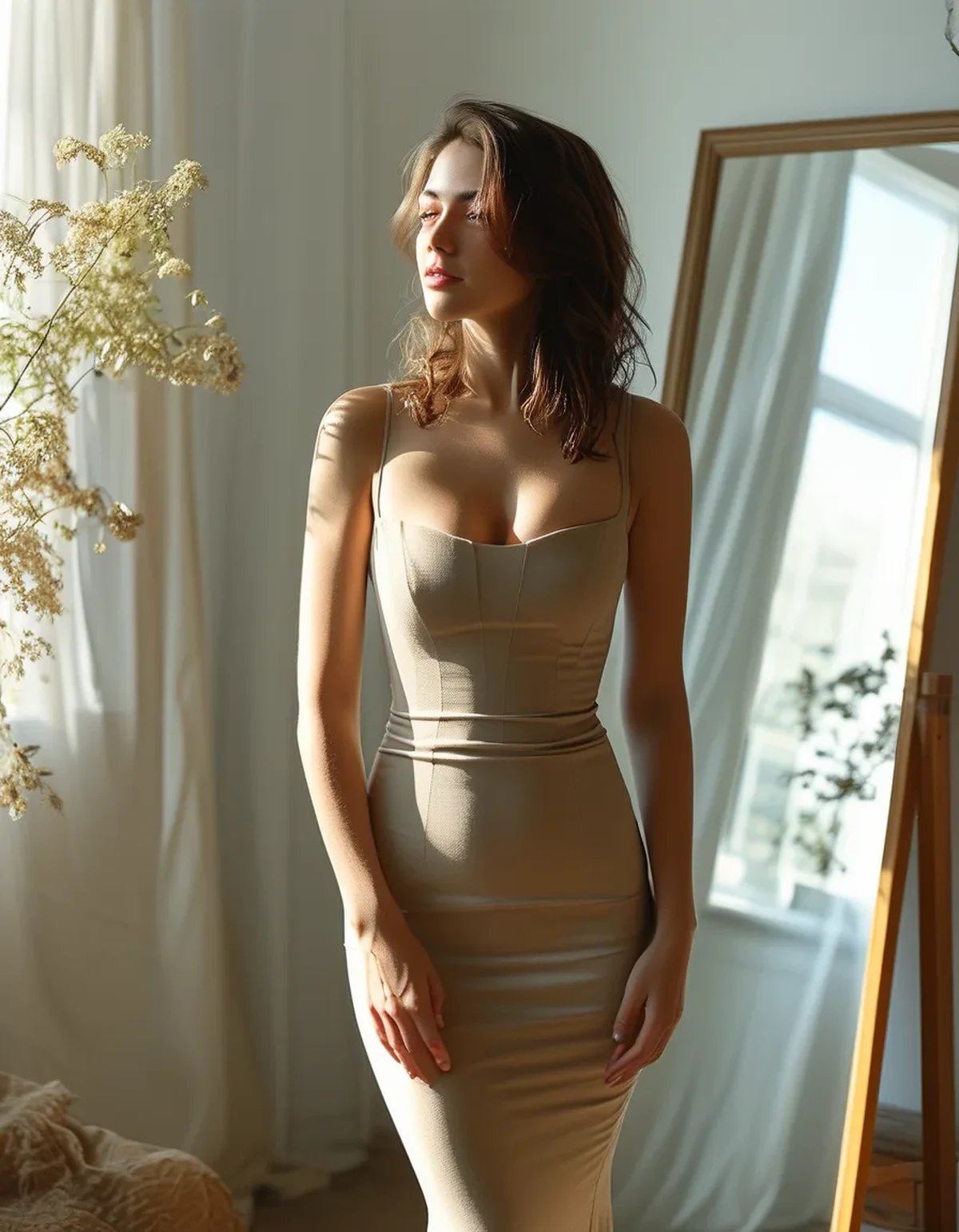
A maxi skirt contains substantially more fabric than a midi — often half again as much or more, depending on the sweep. That extra weight pulls downward from wherever the garment is anchored. In a waisted dress, the waist seam takes the load. In a shift or a column dress, the shoulders take it.
When the shoulders take the load, the bodice is pulled down, which effectively shortens the space available between shoulder and bust. On a fuller bust, that shows up immediately as pulling across the chest or gaping at the button placket, in a garment that measured perfectly fine on the hanger.
When the waist seam takes the load, the waist is pulled downward and slightly outward, so a waist that sat neatly on a midi sits lower and looser on a maxi. On a long torso this is compounded, because the seam was already sitting slightly low.
What does being tall do to the same problem?
It amplifies both ends of it.
A tall frame usually means a longer torso, a longer distance from shoulder to bust apex, and a longer rise. Standard grading assumes those distances scale with the bust and hip measurements they are actually grading on, which they do not.
So when you size up to solve a pulling bodice, you get a garment that is wider everywhere rather than longer where you needed it. The shoulders drop off, the armholes go low, the waist sits wide, and the fit problem has been traded rather than solved.
Add a curvier shape and the standard grading assumption — that all measurements increase together in fixed ratios — breaks down further. The result is the very familiar situation of needing one size for the bust, another for the waist and a third for the length, in a garment that is only sold in one number.
Which measurement should you actually fit to?
The one that cannot be altered, which is almost always the shoulder and upper chest.
A useful hierarchy for tall curvy dressing:
Fit the shoulder first. The shoulder seam should sit at the edge of your shoulder. This is the hardest and most expensive thing to alter, and a badly fitting shoulder makes an otherwise good dress look wrong from across a room.
Fit the bust second. Pulling across the bust, or gaping between buttons, cannot be fixed by a tailor without significant reconstruction. Size to the bust and alter down elsewhere.
The waist is negotiable. Taking a waist in is one of the simplest and cheapest alterations, typically the cost of a couple of coffees at a local tailor.
The hem is entirely negotiable. Lengthening is limited by the hem allowance, but shortening is straightforward. Buying long and shortening is nearly always the better direction for a tall frame, because you cannot add fabric that is not there.
So the practical rule is: buy for the top half, alter the bottom half.
Myth vs Fact: Tall and Curvy Dress Sizing
Myth: Tall ranges solve the problem. Fact: Tall ranges typically add length in the leg and hem, and often add far less through the torso and rise. If your fit issue is a long torso, a tall range may not address it at all.
Myth: A maxi is more forgiving than a midi. Fact: A maxi hides the leg and exposes the bodice, because of the fabric drag described above. A midi with a good bodice is usually the more forgiving garment.
Myth: Stretch fabric means you can ignore fit. Fact: Stretch fabric distributes tension, which means a poor fit shows up as horizontal drag lines rather than as pulling. It is less obvious and no more comfortable.
Myth: Sizing up is the answer to a tight bodice. Fact: Sizing up adds width, not vertical length. If the problem is vertical — a bodice too short for your torso — sizing up makes the garment baggy while barely improving the original issue.
Myth: Alterations are for expensive clothes only. Fact: A £15 to £25 waist take-in or hem on a mid-priced dress you will wear thirty times is one of the best value decisions in a wardrobe. The cost per wear maths is not close.
FAQ: Tall Curvy Fit Questions, Answered
How do I know if a bodice is too short for my torso?
Check where the waist seam sits when you stand naturally. If it lands above your natural waist and pulls upward when you raise your arms, the bodice is short. On a long torso this is extremely common and is the single most useful thing to check before buying.
Should I buy midi or maxi for a long frame?
Both work, but they need different structures. For maxi, look for a defined waist seam and a supportive bodice rather than a shift shape, so the shoulders are not carrying all the fabric weight.
Is a wrap dress genuinely better?
Often yes, because a wrap adjusts at the waist independently of the bust, which is exactly the flexibility standard grading does not give you. Check the wrap depth though — many are cut for shorter torsos and sit low.
TL;DR:
- A maxi carries far more fabric weight, which pulls the bodice down and changes the fit above the waist.
- Standard grading adds width rather than torso length, so sizing up trades one fit problem for another.
- Fit the shoulder and bust — the parts you cannot alter — and treat waist and hem as alterations.
- Choose maxis with a defined waist seam, and check where the waist seam actually lands before buying.
The size on the label was never really the variable. The length of the skirt was.
Keep Reading
This article is for general informational and styling purposes only. Fit, sizing, and product availability may vary.