Why Buying Tall and Curvy Separately Works Better Than Finding One Brand
Quick Answer: Brands grade sizes by scaling a single fit model, so a size that adds width also adds a little length and a size that adds length assumes standard proportions. Tall-and-curvy sits diagonally across that grid, where the fewest garments exist. Buying each half of an outfit from whichever brand serves that piece best, and budgeting for alterations, produces better results than searching for one brand that does both.
You have a mental list of brands that do tall, and a separate list that does curve, and the overlap is roughly two labels, both of which have let you down.
That is not bad luck and it is not you being difficult to dress. It is a direct consequence of how ready-to-wear sizing is constructed, and once you see the mechanism the shopping strategy changes completely.
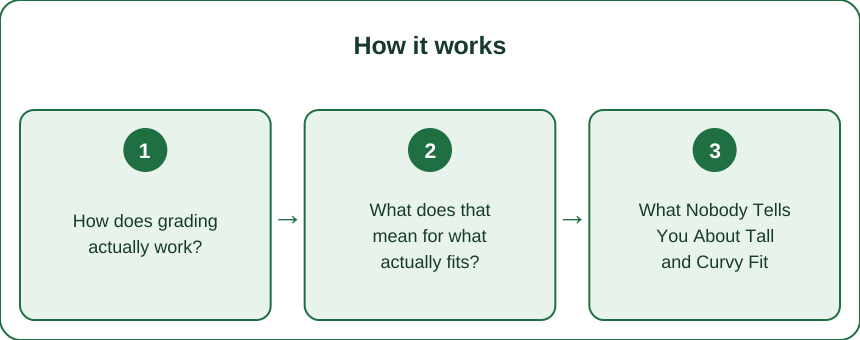
How does grading actually work?
One base pattern, scaled up and down by rules.
A brand fits a garment on a single fit model, usually around a US 8 and usually around 5ft 8. That pattern is then graded - each size up adds a set amount at the bust, waist, and hip, and a smaller amount at the length. Each size down subtracts the same.
The assumption baked into that process is that bodies get larger proportionally. Someone two sizes up is assumed to be slightly taller as well as wider, in a fixed ratio.
Real bodies do not vary along one axis. Height and circumference are largely independent, and someone who is tall and curvy is far from the base pattern in two directions at once.
Tall ranges address this by taking the standard grade and adding length - typically an inch or two in the sleeve and two to three in the inseam and body. But they usually keep the standard circumference assumptions, and they often stop at a smaller top size than the main range does.
Curve ranges do the reverse. They regrade for a different body shape, usually with a larger bust-to-waist and waist-to-hip difference, and they generally use standard heights.
So the two ranges solve different problems using different base patterns, and a brand offering both would need a third pattern set. Very few do, because the production cost is real and the perceived market is small.
What does that mean for what actually fits?
It means different garments fail in completely different ways, which is the key to the strategy.
Length-critical, width-forgiving garments should come from tall ranges: trousers, jeans, sleeves on anything, maxi dresses, coats. If the garment’s main failure mode is being too short, tall sizing solves it and the width can usually be taken in.
Width-critical, length-forgiving garments should come from curve ranges or from regular ranges sized up: knitwear, tops without a defined waist, wrap styles, anything with stretch. If the main failure is straining across the bust or hip, the curve grade solves it and a slightly short body is often acceptable or fixable.
Garments that are critical in both - tailored blazers, shirts, structured dresses - are where the compromise lives, and they are where alterations earn their money. Buy for the largest measurement and the length, then have the rest taken in.
This reframes the problem usefully. Instead of finding a brand that dresses you, you are matching each garment category to the sizing system that solves its dominant failure mode. It also means your wardrobe will come from more places, which feels less tidy and works considerably better.
What Nobody Tells You About Tall and Curvy Fit
Rise is the measurement that matters most and is listed least. For a tall body, front and back rise determine whether trousers sit at your actual waist or three inches below it, and rise is graded inconsistently between brands. Two pairs with identical waist and inseam can fit completely differently because of it.
Shoulder width is the one thing you cannot alter cheaply. Taking in a waist is straightforward, shortening a hem is trivial, and moving a shoulder seam is major surgery. Buy jackets and structured tops for the shoulders and alter everything else, which is the oldest tailoring advice there is and the most useful here.
Stretch fabric fails tall bodies differently. A knit that stretches to fit your circumference will also stretch lengthways over a longer torso, which thins the fabric and makes it sheer exactly where you least want it. This is why the same legging is opaque on a shorter person and not on you, and it is a fabric weight issue rather than a quality one.
Petite ranges are occasionally useful. For a long-torsoed tall woman, a petite-length top is sometimes the right proportion under a jacket, and cropped styles from regular ranges frequently land as normal length. Ignoring an entire range on principle costs options.
And alterations are cheaper than people think. Taking in a waist, shortening sleeves, or adding a dart typically costs a fraction of the garment price. Budgeting fifteen percent of a garment’s cost for alterations transforms what is available to you.
How do you build the wardrobe in practice?
Measure once, sort by failure mode, and stop looking for a single answer.
Take five measurements and write them down: bust, waist, hip, inseam, and front rise. Front rise is the one nobody measures and the one that explains most trouser disappointments. Carry them in your phone.
Sort your shopping by dominant failure mode, not by brand. Length-critical to tall ranges, width-critical to curve ranges, both-critical to whatever fits the largest measurement plus a tailor.
Find one alterations person and use them regularly. This changes the calculation on every purchase, and the relationship matters - someone who knows your proportions will suggest things you would not think to ask for.
Buy fewer, better, and alter them. Three well-fitting pieces from three different brands beat eight compromises from one, and the cost per wear works out lower.
Check the size chart rather than the size label, every time. Vanity sizing means the number is close to meaningless across brands, and the chart takes ten seconds to read.
And use autumn deliberately. This is when coats, boots, and tailoring come into the shops, and those are exactly the categories where tall-and-curvy fit is hardest and where the stock is best in September and October. A coat bought in November is bought from what is left.
FAQ: Tall and Curvy Sizing Questions, Answered
Is it worth ordering multiple sizes to try at home?
For categories where fit is hard, yes - it is effectively a fitting room and most retailers accommodate it. Check the returns policy first, and be honest with yourself about actually sending things back.
Should I size up and alter, or size down and hope for stretch?
Almost always size up and alter. Fabric can be removed cleanly and cannot be added. The exception is stretch knitwear where sizing up produces a sloppy shoulder, since shoulders cannot be fixed easily.
How do I judge fit online with no fitting room?
Compare the garment measurements - not the size chart of body measurements - against a garment you already own that fits well. Laying a favourite pair of trousers flat and measuring the rise, thigh, and inseam gives you a target that transfers across brands in a way that dress sizes never do.
TL;DR:
- Brands grade from one fit model, so tall ranges add length with standard widths and curve ranges add width with standard heights.
- Match each garment to the sizing system that solves its dominant failure mode rather than looking for one brand that does everything.
- Buy for the shoulders and the length, then alter the waist - shoulders are the one thing that cannot be fixed cheaply.
- Measure rise as well as inseam, budget for alterations, and buy autumn tailoring early while the stock is complete.
The brand that does both mostly does not exist because the pattern-making does not support it. Once you stop searching for it, the wardrobe gets considerably easier to build.
Keep Reading
This article is for general informational and styling purposes only. Fit, sizing, and product availability may vary.