Why Autumn Layering Is Harder for Tall Curvy Women Than for Either Alone
Quick Answer: Standard layering advice assumes the layers stack neatly because each garment sits where it was designed to. On a tall curvy body the base layer runs short in the torso, the mid layer sits high across the bust and rides up, and the outer layer strains at the widest point while gaping above it. The fix is to solve the layers in the opposite order to the usual advice - choose the outer layer for the bust, the mid layer for torso length, and the base layer last, where the fit compromise costs the least.
The outfit worked perfectly with one layer.
Add a knit and it pulls across the chest, add a jacket and the whole thing rides up until nothing sits where it started.
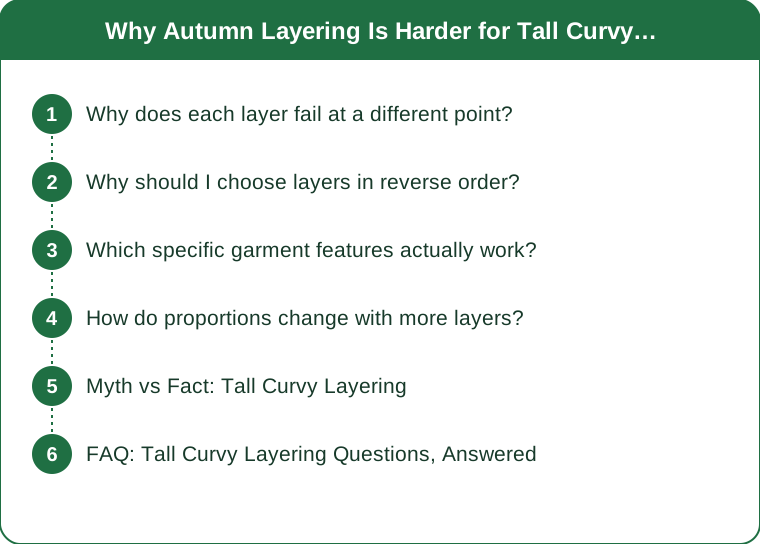
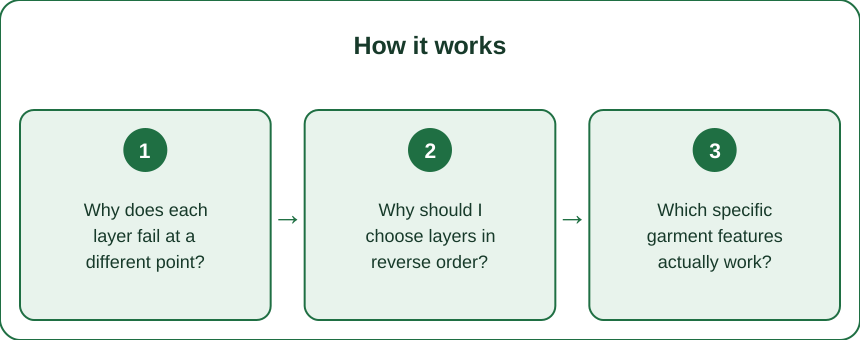
Why does each layer fail at a different point?
Base layers fail on torso length. A long torso pulls a standard top up from the hip, which is why base layers untuck and expose a gap the moment you move.
Mid layers fail across the bust. A knit sized to fit the bust is oversized everywhere else; a knit sized to the body pulls horizontally and rides up at the front hem.
Outer layers fail at the shoulder and the button line, because outerwear is drafted for a narrower bust-to-shoulder ratio than a curvy fit needs.
And the failures compound. A mid layer riding up drags the base layer with it, and a jacket that strains at the bust exaggerates both.
Standard layering advice ignores this entirely because it addresses one dimension at a time.
Which is why the outfit that worked in one layer stops working in three.
Why should I choose layers in reverse order?
Because the outer layer is the least forgiving and the hardest to substitute. Solve it first and everything underneath can be adapted.
Choose the coat or jacket for the bust and shoulder, accepting some looseness at the waist, which can be belted or left open.
Then choose the mid layer for torso length, which is the dimension that produces the riding-up problem across the whole outfit.
Then the base layer last, where a fit compromise is least visible and where longline options are most widely available.
The conventional order - base first, then build - locks you into a base that the outer layer cannot accommodate, which is why it produces the strain and gape combination.
And working from the outside means fewer purchases, since one well-chosen outer layer works over multiple mid layers.
Which specific garment features actually work?
Longline base layers, explicitly labelled as such, which solve the untucking problem more reliably than sizing up.
Open-front mid layers - cardigans, wraps, unbuttoned shirts - which remove the horizontal strain across the bust entirely by not crossing it.
V-necks and open necklines, which break up the area across the chest and reduce the widening effect of a high round neck.
Outerwear with a defined waist or a belt, which lets you take in the waist that had to be oversized to fit the bust.
Vertical detail in the outer layer - a long lapel, a seam line, an open front - which lengthens rather than widens.
And knits in a fine gauge rather than chunky, since bulk at the bust adds where it is least needed while a fine gauge layers under outerwear without strain.
How do proportions change with more layers?
Every layer shortens the visible leg line, which matters more on a long torso where the waist already sits low relative to total height.
Keep at least one layer cropped or tucked at the front, which restores the waist point that layering otherwise buries.
Avoid three layers all ending at different points near the hip, which creates horizontal lines exactly where the eye should not be drawn.
Stagger lengths deliberately: short, medium, long, rather than three similar hemlines within ten centimetres of each other.
A long outer layer over a shorter mid layer works better than the reverse, which is a small rule that fixes a great deal.
And full-length bottoms rather than cropped, since ankle gaps shorten the line further once the top half has gained volume.
Myth vs Fact: Tall Curvy Layering
Myth: sizing up solves a bust fit problem.
Fact: it adds width everywhere, including the shoulders and waist, which produces a garment that fits the bust and hangs off everything else. Choosing for the bust and altering the waist is the better route.
Myth: layering makes you look bigger, so tall curvy women should avoid it.
Fact: badly proportioned layering does. Staggered lengths, open fronts and vertical lines add warmth without adding visual width, and skipping layers in autumn is a worse trade.
Myth: you should buy the base layer first.
Fact: on a tall curvy frame the outer layer is the constrained item. Solving it first and adapting underneath produces fewer failed purchases.
Myth: chunky knits are cosier and therefore better for autumn.
Fact: fine gauge layers under outerwear without strain and produces the same warmth in combination. Chunky knits add bulk precisely at the bust, where it is least useful.
Myth: tall curvy is just a bigger version of tall.
Fact: they are different fit problems that interact. A tall size solves torso and sleeve length and frequently makes the bust fit worse, because tall ranges are often drafted on a narrower block. Both have to be addressed.
FAQ: Tall Curvy Layering Questions, Answered
Should I buy tall sizing or curve sizing when I need both?
Where a brand offers both together, that is ideal. Where it does not, buy for the bust and shoulder and adjust length where possible, since length is more often alterable than a bust fit.
What is the single most useful layering piece?
An open-front longline cardigan or knit. It solves the bust strain problem by not crossing the bust and adds a vertical line that layering otherwise removes.
How do I stop my base layer riding up?
Buy longline base layers explicitly, rather than sizing up. Sizing up adds width and only a small amount of length, which does not solve it.
Do I need a belt with outerwear?
If you had to size up to fit the bust, a belt reclaims the waist and is the cheapest way to make oversized outerwear look intentional.
What hemlines should I avoid stacking?
Three layers all ending within about ten centimetres of each other near the hip. Stagger them deliberately - short, medium, long.
Are wrap styles good for this shape?
Generally yes, since they adjust to the bust rather than fighting it and create a V neckline. Check the closure holds during movement.
How many layers is too many?
Three is usually the practical ceiling before proportion problems outweigh warmth. Beyond that, a warmer outer layer is a better answer than a fourth thin one.
TL;DR:
- Each layer fails at a different point: base on torso length, mid across the bust, outer at the shoulder.
- Choose in reverse order - outer layer first for the bust, mid layer for torso length, base layer last.
- Open-front mid layers remove bust strain entirely by not crossing it.
- Stagger hemlines short, medium, long; three similar lengths near the hip is the worst combination.
- Fine gauge knits layer under outerwear; chunky adds bulk exactly where it is least useful.
Solve the constrained layer first and adapt underneath.
Keep Reading
This article is for general informational and styling purposes only. Fit, sizing, and product availability may vary.