Why Tall Curvy Sizing Fails Worse in Stretch Fabric Than in Woven
Quick Answer: Stretch fabric conceals a fit that is wrong in two dimensions at once. It borrows length from width - pulling around the hips takes fabric away from the vertical, so a knit that fits in the changing room rides up, shortens, and slides through the day. Woven fabric fails immediately and visibly, which is actually more useful information. For a tall curvy frame, buy woven for structure and knit only where you have checked the length under tension. Test knits by sitting, not by standing.
Stretch does not fix a two-dimensional sizing problem.
It postpones it until you are out of the shop.
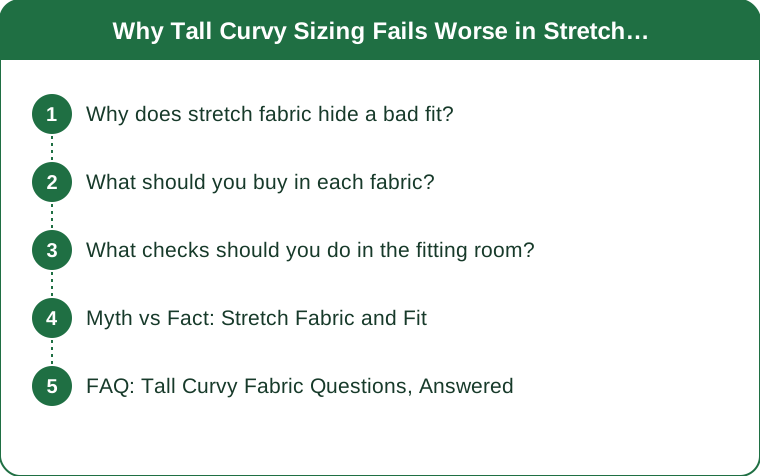
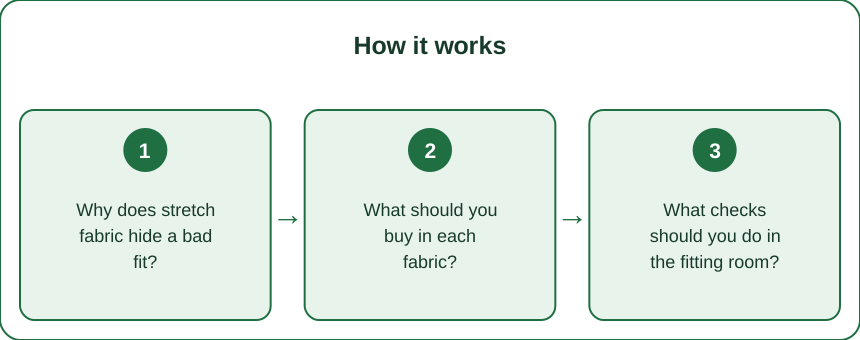
Why does stretch fabric hide a bad fit?
Because it can borrow from one direction to serve another, and you only see the result later.
Knit fabric deforms rather than resisting. A woven fabric pulls, creases, and gapes when it does not fit - all of which you can see standing still. A knit simply stretches and looks fine while sitting at a much higher tension than it should be.
Width and length come from the same fabric. When a knit stretches around the hips, that fabric has to come from somewhere, and it comes from the vertical. A dress that fits in the hips and reaches your knee standing still can lose meaningful length when you sit - the fabric is redistributed, not created.
Which is exactly the tall curvy problem. You need length in the vertical and room in the horizontal, and stretch fabric makes them compete. Solving the width creates the length problem.
Tension also changes opacity. Fabric stretched near its limit is thinner and more transparent. The seat of a knit skirt or dress is where this shows first - and it is not visible in a standing mirror.
And recovery gets worse across a day. Knits stretched to their limit for hours do not fully return, which is why a garment that fit at 9am sits badly at 6pm. Bagging at the knees and seat is the fabric giving up, not a laundry problem.
Woven fabric, by contrast, tells you immediately. If it does not fit, it pulls or gapes in the shop. That is unhelpful in the moment and extremely helpful overall.
What should you buy in each fabric?
Split by function - woven where structure matters, knit where movement does, and different checks for each.
Buy structured pieces woven. Blazers, trousers, shirt dresses, and anything you want to hold a line. A woven piece that fits your widest measurement and is then altered elsewhere is the most reliable route to a tall curvy fit that lasts.
Buy woven with alteration in mind. Woven can be taken in at the waist while keeping the hip room. Knit generally cannot be altered well - taking in a knit changes how it stretches and usually distorts.
Buy knit for movement, and check it under tension. Leggings, tops, and casual dresses. The test is sitting down, not standing up.
Prefer knits with a higher recovery content. A knit with a meaningful elastane content bounces back far better than a plain cotton jersey, which stretches and stays stretched. Plain cotton jersey is the worst option for a shape that puts tension on it.
Look for ponte and scuba weights for dresses. Heavier stable knits hold their shape under tension in a way that thin jersey does not. They also skim rather than cling, which is a separate benefit.
And check the length after the width. Try a knit in the size that fits your hips comfortably rather than snugly, then check the hem sitting down. A knit dress needs more standing length than a woven one to end up in the same place seated.
What checks should you do in the fitting room?
Four, taking under two minutes, and all of them involve moving.
Sit down fully in every knit. Hem position, waistband position, and whether the fabric goes shiny or thin across the thigh. The seated check is the entire test for a knit garment.
Raise both arms. A knit top borrows length from the body to reach the arms, which is why tops ride up. If the hem lifts above your waistband with arms up, it will do it all day.
Check the seam positions, not the size. Where the side seam sits, whether the waist seam lands at your natural waist, and whether the shoulder seam sits on the point of your shoulder. Seam placement is the honest measure of fit and it does not lie the way stretch does.
Look at the fabric in bright light while bent. Opacity under tension is the single most common late failure. Two seconds of bending in daylight saves a garment you would otherwise wear once.
Ignore the size on the label completely. Tall and curvy sizing is inconsistent between brands to the point of being meaningless. Compare measurements against your own numbers, which you should know: bust, waist, hip, inseam, and torso length.
And buy the size that fits your largest measurement. Then alter down elsewhere. Trying to squeeze into a smaller size because the length is right is the trade that produces the transparent, riding-up result.
Myth vs Fact: Stretch Fabric and Fit
Myth: stretch means one size fits more shapes. Fact: stretch means one size looks acceptable on more shapes for a short time. Fit and appearance-of-fit are different things, and knits are excellent at the second.
Myth: if it fits standing, it fits. Fact: knits redistribute fabric under load, so standing tells you almost nothing about how a garment behaves seated or moving. The standing mirror is the least informative test available.
Myth: sizing up in a knit fixes the length. Fact: sizing up adds width everywhere, which usually means a gaping waist and shoulders that fall off, while adding relatively little length. Length comes from a tall cut, not from a larger size - this is the single most expensive misunderstanding in tall sizing.
Myth: thicker knits are less flattering. Fact: heavier stable knits skim rather than cling and hold their shape all day. Ponte and scuba are usually more flattering on a curvy frame than thin jersey, not less.
Myth: knits do not need tailoring. Fact: they need it more in some ways and accept it less. Which is precisely the argument for buying structured pieces woven and reserving knits for things that do not need to hold a line.
Myth: a bad fit is your body’s fault. Fact: standard grading assumes measurements scale together, and they frequently do not. A garment that fits in one dimension and fails in the other is a grading limitation, not a personal one.
FAQ: Tall Curvy Fabric Questions, Answered
Should I just buy everything woven then?
No - woven has its own limits, particularly for anything you move in. Use woven for structure and knit for movement, and apply the seated test to every knit before buying.
What elastane percentage should I look for?
Enough to give recovery without making the fabric behave like activewear. A modest percentage in a stable knit is generally the sweet spot for clothing that needs to hold its shape across a day.
Why do tall ranges still fail me at the waist?
Because tall grading usually adds length to the legs and sometimes the sleeves, and much less often to the torso. If your length is in your torso rather than your legs, a standard tall range may add length in the wrong place - check the back-neck-to-waist measurement rather than the inseam.
TL;DR:
- Stretch borrows length from width, so a knit that fits your hips loses vertical length exactly where you need it.
- Woven fabric fails visibly in the shop, which is more useful information than a knit’s temporary good fit.
- Buy structure woven and alter it; buy knit for movement and test it seated.
- Heavier stable knits like ponte hold shape far better than thin jersey.
- Sizing up adds width, not length - length has to come from a tall cut.
Next fitting room, sit down in everything before you look in the mirror. That single change filters out most of what would have disappointed you later.
Keep Reading
This article is for general informational and styling purposes only. Fit, sizing, and product availability may vary.