Why Tall Curvy Sizing Fails in the Rise Before Anywhere Else
Quick Answer: Rise is graded far less than length or width across a size run, so a tall curvy body — which needs both a longer rise and more room through the hip — hits the limit on rise first. That is why the trousers that fit your hips still pull down at the back, sit below your natural waist, and gap at the centre back. Measure your own rise and shop by that number before you look at anything else.
Hips fit.
Inseam fits.
And it still sits two inches too low with a gap at the back, because nobody is grading the rise.

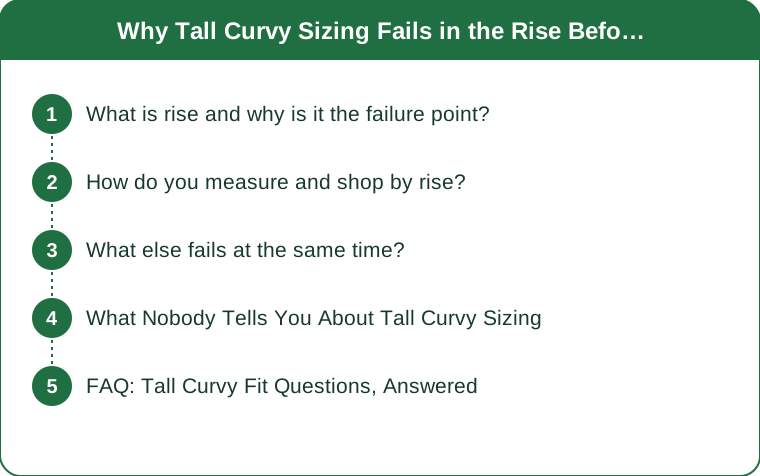
What is rise and why is it the failure point?
Six things worth knowing about the measurement nobody advertises.
Rise is the distance from the crotch seam to the top of the waistband, measured up the front (front rise) and up the back (back rise). Back rise is typically several centimetres longer than front rise to accommodate the seat.
Rise barely changes across sizes. Brands grade width generously across a size run and length somewhat, but rise often changes by only a centimetre or two from the smallest size to the largest. A body that needs significantly more rise cannot get there by sizing up.
A longer torso needs more front rise, and a fuller seat needs more back rise. Tall curvy proportions frequently need both, and most size runs are built assuming that if you need one, you need it modestly.
Insufficient rise pulls the whole garment down. The fabric has to come from somewhere. If the rise is short, the waistband migrates downward to where the available fabric reaches — which is why high-waisted trousers land at mid-hip on you and at the natural waist on someone shorter.
The centre-back gap is a rise problem, not a waist problem. When the back rise is too short, the waistband is pulled forward and down at the sides while the centre back stands away. People diagnose this as a small waist relative to hips, and sometimes it is, but insufficient back rise produces the identical symptom.
Tall ranges usually add inseam, not rise. This is the crucial detail. A tall size in most brands means a longer leg from a fixed crotch point. If your extra height is in your torso rather than your legs, a tall size solves nothing — and that is why some tall women find tall sizing works perfectly and others find it makes no difference at all.
How do you measure and shop by rise?
Six steps that turn this from guesswork into a number.
Measure the rise on a garment that fits you well. Lay it flat, do up the fastening, and measure from the crotch seam straight up to the top of the waistband at the front, then repeat at the back. Write both numbers down. This is now your target.
Compare against your body rise. Sit on a hard chair and measure from the seat surface up to your natural waist at the side. This gives you a body rise number that garment measurements should exceed slightly for comfort.
Look for brands that publish front and back rise. Increasing numbers do, usually buried in a size chart or a product measurements tab. A brand that publishes rise is a brand that has thought about it.
Filter by rise before inseam. Inseam is easy to alter and rise is not. Hemming trousers costs very little; altering a rise means unpicking the crotch seam and is rarely worth it.
Check whether tall sizing adds rise or only inseam. Ask customer service directly if it is not stated. The answer determines whether tall ranges will ever work for you.
For leggings, look for the waistband depth as well. A wide waistband effectively extends the rise. A 12-15cm waistband on a high-rise legging behaves very differently from a 5cm one, and for a longer torso it is often the difference between staying up and rolling down.
Seasonal note: autumn is when this matters most, because layering exposes it. A jumper tucked into a waistband that is already sitting too low creates bulk exactly where you do not want it, and a coat that hits at the same point compounds it. Getting rise right in September pays off for the whole layering season.

What else fails at the same time?
Six related fit problems that share the same root cause.
Tops that ride up when you raise your arms. A longer torso needs more body length, and standard body length is graded even less generously than rise. Look for stated body length measurements, and for tops described as longline rather than sizing up, which just adds width.
The waistband-hem gap. When trousers sit low and tops sit short, the gap between them appears every time you move. It is two separate grading failures meeting in the middle, and it is why tall curvy dressing so often ends up in a longline top over a high-rise anything.
Sports bra underbands that sit wrong. A longer torso changes where an underband naturally sits, and a band designed for average torso length can end up sitting under the bust rather than around the ribcage.
Dress waist seams landing at the wrong point. A fitted dress with a defined waist seam is the most unforgiving garment for a longer torso, because the seam either sits above your waist or the whole bodice pulls. Elasticated or unstructured waists are far more forgiving.
Jacket button placement. A single-button blazer buttons at a fixed point relative to the shoulder. On a longer torso, that point sits higher on you proportionally, which changes the entire look and often reads as a jacket that is too small.
Stretch fabric hides all of this until you move. Static fitting-room fit is not the test. Sit down, squat, and raise your arms in the fitting room. Every one of these problems appears in movement and disappears standing still.
What Nobody Tells You About Tall Curvy Sizing
Nobody tells you rise is the master measurement. Everyone talks about inseam. Rise decides whether a garment sits where it was designed to sit, and everything downstream depends on it.
Nobody tells you that tall sizing might not be for you. Tall ranges typically add leg length only. If your height is in your torso, a tall size adds inches exactly where you do not need them and none where you do.
Nobody tells you to shop by measurements rather than by size name. Size labels are not standardised across brands and barely standardised within them. The published measurements are the only real information.
Nobody tells you that hemming is cheap and rise alteration is not. Buy for the fit you cannot change and alter the fit you can. This one principle reverses how most people shop.
Nobody tells you that a wide waistband is a rise extension. For leggings and activewear specifically, waistband depth does much of the work rise does in woven trousers, and it is a far more commonly published number.
Nobody tells you to keep a measurements note on your phone. Your rise, inseam, torso length, hip and waist, in centimetres. Shopping becomes filtering rather than guessing, and returns drop sharply. It takes fifteen minutes once.
FAQ: Tall Curvy Fit Questions, Answered
What exactly is rise?
The distance from the crotch seam to the top of the waistband, measured separately at the front and the back.
Why do high-waisted trousers sit low on me?
Insufficient rise. The waistband migrates down to where the fabric reaches, regardless of what the product photos show.
Is the centre-back gap a waist problem?
Often it is a back rise problem. A short back rise pulls the waistband forward at the sides and leaves the centre back standing away.
Will tall sizing fix it?
Only if the brand adds rise, not just inseam. Most add inseam only. Ask before buying.
How do I measure my own rise?
Measure a well-fitting garment flat, from crotch seam to waistband top, front and back. Record both numbers and shop against them.
Should I size up for more rise?
Rarely worth it — rise grades very little between sizes, so you gain width you do not need and almost no rise.
What waistband depth should I look for in leggings?
For a longer torso, 12-15cm high-rise waistbands stay put far better than narrow ones.
TL;DR:
- Rise — crotch seam to waistband, front and back — is the measurement that decides fit, and brands barely grade it.
- Insufficient rise pulls the whole garment down, which is why high-waisted styles sit at your mid-hip.
- The centre-back gap is usually short back rise, not a small waist.
- Tall sizing usually adds inseam only — useless if your height is in your torso. Ask the brand.
- Buy for the fit you cannot alter (rise) and hem the fit you can (inseam).
Tonight, measure the front and back rise of the trousers that fit you best and put both numbers in your phone. That is your shopping filter from now on.
See It in Motion
Seen here: Super High Waist Embossed Yoga Leggings with Inner Pocket — shop it on bubblelime.com
Keep Reading
This article is for general informational and styling purposes only. Fit, sizing, and product availability may vary.