Why Tall and Curvy Fit Fails at the Waistband Before the Hips
Quick Answer: Sizing up for hips or thighs adds width at the waist too, but adds very little rise height. For a tall, curvy body the waistband then sits below the natural waist — at the widest part of the torso taper — where it gaps at the back and rolls at the front. Rise, not width, is the measurement that fails.
You did the responsible thing. You measured, the hip number said size up, and you sized up.
Now the thighs fit, the hips fit, and there is a two-finger gap at the small of your back that no belt loop or drawstring resolves.
Most people conclude they are between sizes. They are usually between rises.
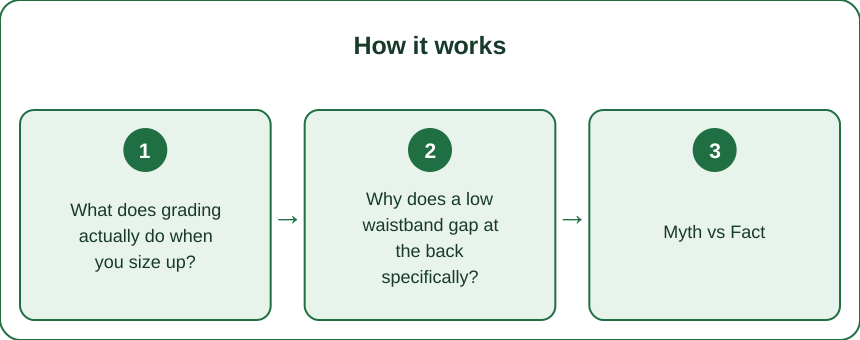
What does grading actually do when you size up?
Apparel brands build one base sample — usually a size medium on a fit model around 5’7” — and then grade every other size from it using fixed increments.
Grading rules add width generously and length stingily. A typical size step adds 1 to 2 inches at the hip and waist, but only about 1/4 to 1/2 inch of rise. Inseam often does not change at all between sizes within the same length designation.
That asymmetry is the entire problem. Going up two sizes for your hips gives you roughly 3 inches more waist circumference and maybe 3/4 inch more rise.
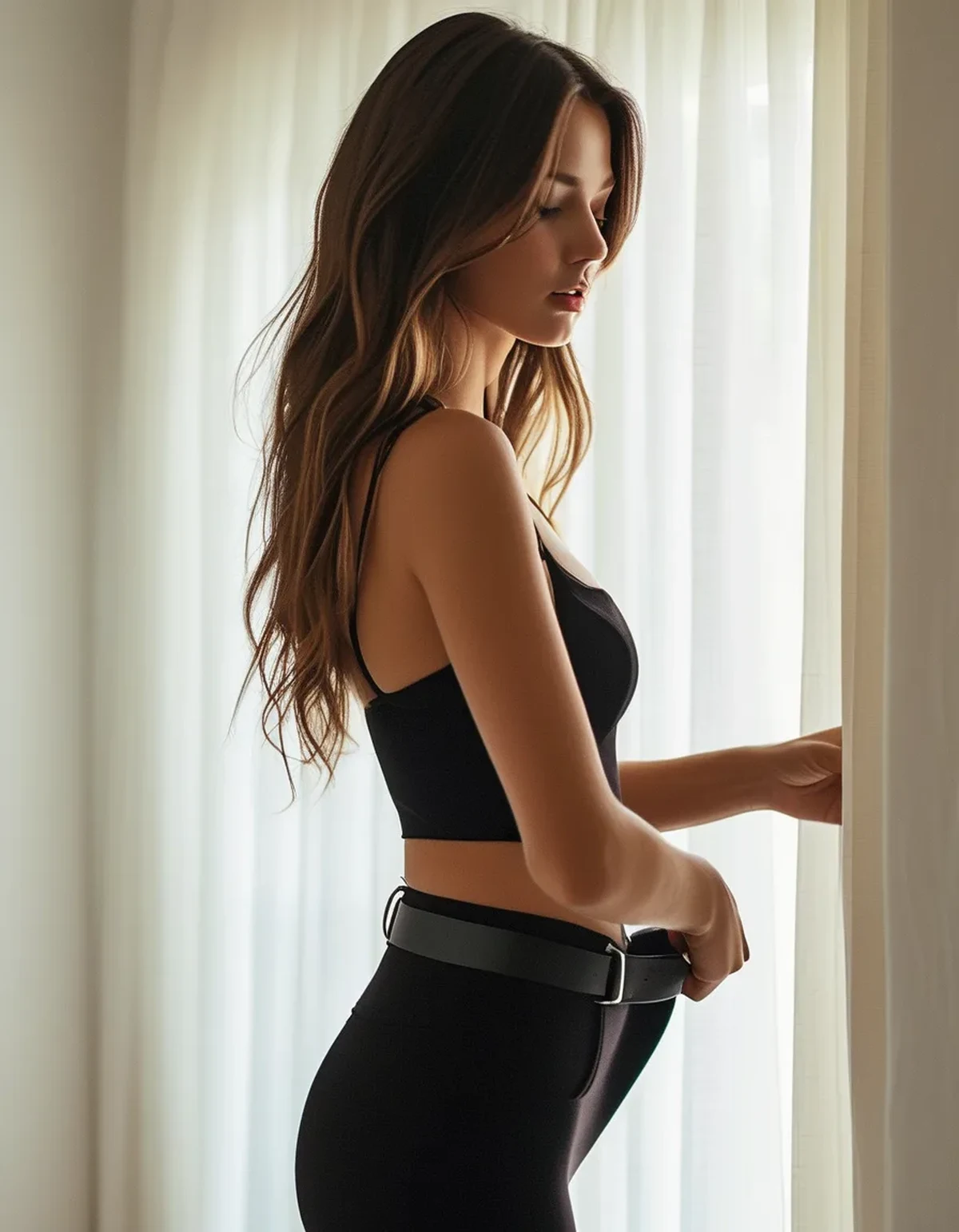
So the garment gets wider around a torso that has not gotten wider at the waist, and the waistband — which needed to travel 2 to 3 inches higher to reach your natural waist — barely moves. It lands low, on the flare of your hip, which is the worst possible seat for it.
Why does a low waistband gap at the back specifically?
Because the distance from waist to hip is not symmetrical front to back.
On a curvy body, the back rise — measured from the waist over the seat to the crotch seam — is meaningfully longer than the front rise. A pronounced lumbar curve increases that difference further.
Most mass-market patterns are drafted with a modest front-to-back rise differential. When your body needs more back rise than the pattern provides, the fabric is pulled downward over the seat, and the waistband tips forward at the top.
That tipping is what creates the gap. The waistband is not too big in circumference — measure it and it is often correct. It is angled wrong, so it stands away from your lumbar curve while sitting flush at the front.
This is why taking in the back seam works so well as an alteration and why belts do not: a belt tightens a circumference that was never the problem.
Myth vs Fact: tall curvy waistband problems
Myth: A gapping waist means you should size down. Fact: Sizing down usually gives you a waistband that still sits too low, now digging in, with thighs that no longer fit. The gap is about rise and angle, not overall size.
Myth: High-rise always solves it. Fact: High-rise as labeled by a brand is measured on their fit model. A 11 inch rise that is high-rise at 5’6” is a mid-rise at 5’11”. Read the actual rise measurement, not the category name.
Myth: Drawstrings fix waist gap. Fact: A drawstring gathers fabric evenly around the whole circumference. Your gap is localized to the back. Cinching creates bunching at the front and sides while the back still stands away.
Myth: Only expensive brands get this right. Fact: Price correlates weakly. What correlates strongly is whether a brand publishes rise measurements by size and offers a genuine tall block rather than just a longer inseam.
What measurements should you actually be shopping by?
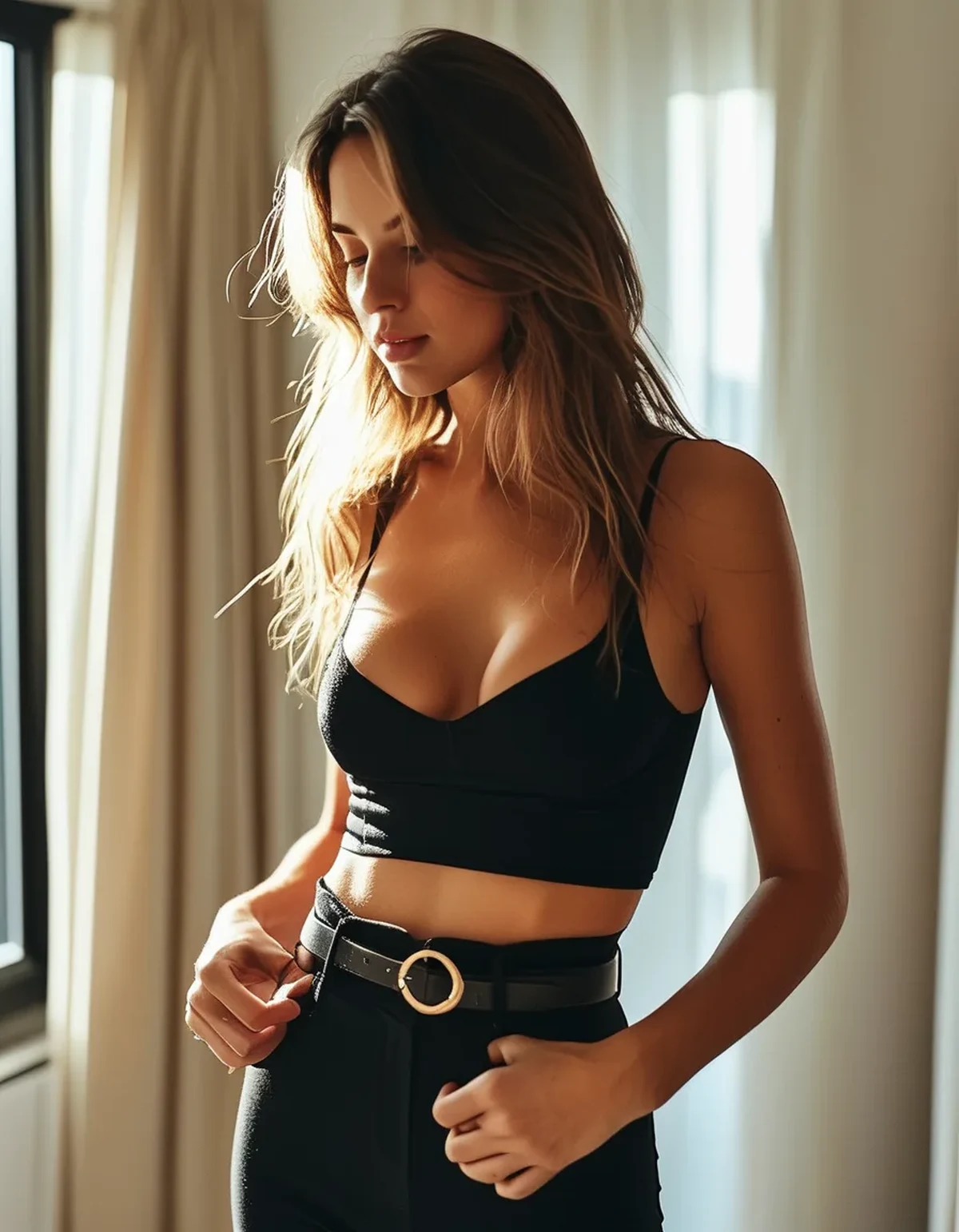
Three numbers, and only one of them is the one on most size charts.
Your front rise need. Measure from the crease at the top of your thigh, up the front of your body, to your natural waist — the narrowest point, usually about an inch above your navel. For most tall curvy bodies this is 11 to 13 inches.
Your back rise need. Same measurement up the back over the fullest part of the seat. Expect this to be 1.5 to 3 inches longer than the front. The bigger that difference, the more you need a curved-waistband or contoured-yoke design.
Your waist-to-hip drop. Hip measurement minus waist measurement. At 12 inches or more, straight-cut waistbands will gap on you regardless of rise, and you should be filtering for contoured or V-shaped waistbands specifically.
Once you have these, ignore the size letter entirely. Shop by published rise, and if a brand does not publish it, email and ask — the ones that answer are the ones worth buying from.
What design features actually solve it?
Certain construction details are reliably better for a long torso with a high waist-to-hip drop.
Contoured or V-back waistbands. A waistband cut with a curve, or dipping higher at the center back, follows the lumbar curve instead of fighting it. This is the single most effective feature.
Wide waistbands, 4 inches or more. They distribute pressure across a taller band and are less likely to tip, roll, or fold over.
Elastic with fabric-covered channels rather than exposed elastic. Exposed elastic is more likely to roll on a curved torso.
Yoke seams at the back. A horizontal seam across the seat lets the pattern add shaping exactly where a curvy body needs it — a detail borrowed from good denim.
A genuine tall block. Some brands cut their tall range with a longer rise and higher knee placement, not just extra inches at the ankle. Look for language about proportional grading; if the only difference is inseam, it is not a tall block.
For a garment you already own and love, a tailor can take in the back waistband — typically $15 to $25, done in a day, and it turns a nearly-right pair into the pair you reach for.
FAQ: Tall Curvy Fit Questions, Answered
Are tall sizes always the answer?
Not always. If your extra height is mostly in your legs, a regular rise in a long inseam works fine. If your height is in your torso — which you can check by comparing your seated height to friends of the same standing height — tall sizing is essential.
Does higher compression fabric fix waist gap?
It masks it. Strong compression pulls the band against your back and hides a small gap, but it also digs at the front and can roll down under movement. It is a workaround, not a fit solution.
Why do the same size and brand fit differently across styles?
Because rise and waistband construction change between styles even within a brand. Note the rise measurement of a pair that fits you and use that number as your filter — it travels across brands far better than a size label does.
TL;DR:
- Sizing up adds inches of width but only fractions of an inch of rise, so the waistband lands too low.
- Curvy bodies need more back rise than front, and standard patterns under-deliver it, tipping the band forward.
- Shop by measured front rise, back rise, and waist-to-hip drop — not by size label or the words high-rise.
- Contoured V-back waistbands, 4-inch bands, and true tall blocks are the features that actually work.
The gap at your lower back has been telling you something specific this whole time: the waistband is in the wrong place, not the wrong size. Once you shop by rise, the number of pairs that work goes up sharply — and so does the number you actually wear.
Keep Reading
This article is for general informational and styling purposes only. Fit, sizing, and product availability may vary.