Why Swimsuits Never Quite Cover Right When You're Tall and Curvy
Quick Answer: Swimsuit torso lengths are built around a narrower size range than the bust and hip measurements they’re paired with, so a suit sized correctly for curves is often too short in the torso for height — leading to riding up. Look specifically for ‘long torso’ or extended-length one-piece lines.
You sized up for the bust and hip fit, and now the torso panel is riding into places it shouldn’t by the second time you sit down.

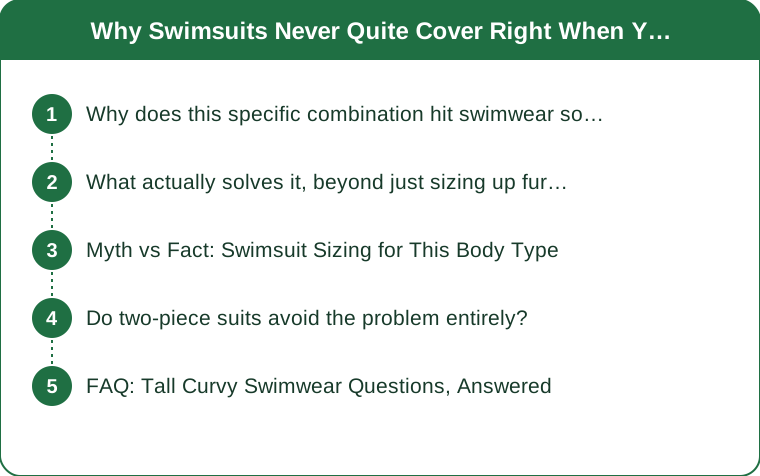
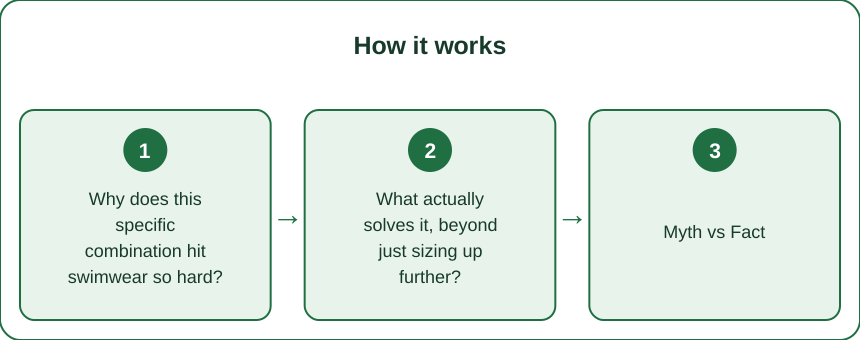
Why does this specific combination hit swimwear so hard?
Most swimsuit grading scales torso length with cup and hip size, not height. So sizing up for curves adds width and coverage in the bust and hip, but the torso panel length barely changes — leaving a proportionally shorter torso for a taller frame.
This is different from how most other clothing categories grade, which is part of why the problem feels specific to swimwear.
What actually solves it, beyond just sizing up further?
Long-torso or ‘tall’ specific swimwear lines are the most direct fix — several mid-size and larger swim brands now offer these as a separate fit category, not just a size number. High-cut leg lines on one-pieces also help visually and functionally, since they reduce how much torso length the fabric needs to cover before it starts riding.
Adjustable strap length matters too — shoulder straps that can be lengthened take pressure off the torso panel pulling upward.
Myth vs Fact: Swimsuit Sizing for This Body Type
Myth: Sizing up always fixes torso length issues. Fact: Sizing up adds width, not necessarily length — the two aren’t linked in most standard grading.
Myth: Two-piece suits solve the torso problem automatically. Fact: They remove the torso-length issue entirely for the top, but bottoms can still ride if the rise is too short for hip and torso proportions.
Myth: This is a rare, hard-to-shop-for combination. Fact: It’s common enough that several swimwear brands have built dedicated size categories specifically for it in recent years.
Do two-piece suits avoid the problem entirely?
Largely, yes for the torso-length issue specifically, since there’s no single panel that needs to stretch from bust to hip. The tradeoff is bottom rise still needs attention — a high-waisted bottom with a longer front rise tends to stay put better than a low-rise cut on a longer torso.
FAQ: Tall Curvy Swimwear Questions, Answered
What measurement should I check before buying a one-piece?
Torso length (shoulder seam to crotch) listed in the size guide — not just bust and hip measurements — is the number that predicts riding-up issues.
Are long-torso swimsuits harder to find in larger sizes?
They’re improving but still less common than standard sizing; searching ‘long torso plus size swimsuit’ specifically surfaces more relevant options than general swimwear searches.
Does fabric type affect how much a suit rides up?
Yes — suits with more compression and less stretch recovery tend to ride up faster than those with strong 4-way stretch and good elastane recovery.
TL;DR:
- Swimsuit torso length scales with cup and hip size, not height, causing riding-up for tall-curvy frames
- Dedicated long-torso or tall swim lines solve this more directly than sizing up further
- Two-piece suits remove the torso-length issue but still need attention to bottom rise
- Check torso length in the size guide, not just bust and hip numbers
The fit problem isn’t your body — it’s a sizing system that rarely lets height and curves scale independently.
Keep Reading
This article is for general informational and styling purposes only. Fit, sizing, and product availability may vary.