Why Rise Height Matters More Than Waist Size for Tall Curvy Fit
Quick Answer: Rise height (the distance from crotch seam to waistband) matters more than waist measurement for tall curvy fit because a torso that’s both longer and curvier needs more vertical room between hip and natural waist than a standard rise chart accounts for — getting the waist number right with the wrong rise still results in gapping, digging, or a waistband that sits at the wrong point entirely.
Most sizing advice focuses on waist and hip measurements alone, which is exactly the part of the equation that’s already usually fine — rise is the overlooked variable causing most fit complaints.
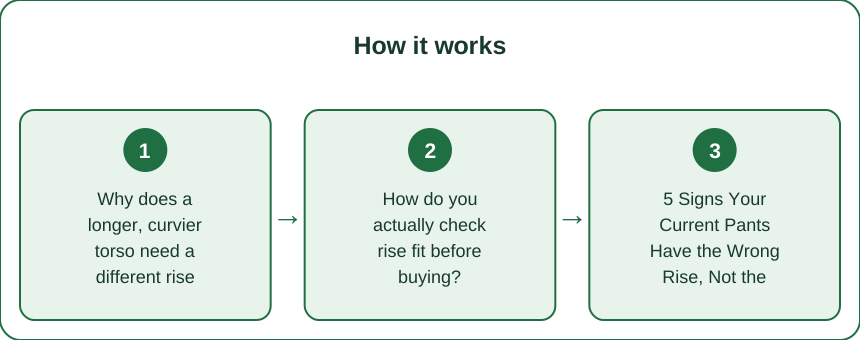
Why does a longer, curvier torso need a different rise specifically?
Because the vertical distance between the hip’s widest point and the natural waist is longer on a tall curvy frame than the rise charts most brands build around, which are typically proportioned for average torso length. A standard or even ‘high’ rise cut for an average torso can land at the same low point on a tall curvy body that it would land higher on a shorter frame.
How do you actually check rise fit before buying?
Measure your own front rise — sitting down, measure from your natural waist, through your crotch, to the chair seat — and compare it to a brand’s listed front rise measurement (not just the size chart’s waist/hip numbers) before ordering. Most fit issues get diagnosed at this step, before the garment even arrives.
5 Signs Your Current Pants Have the Wrong Rise, Not the Wrong Size
1. Gapping at the back waistband even though the waist measurement fits — usually a rise that’s too short for your torso length, not a waist that’s too large.
2. Digging in at the front when sitting, even with room in the waistband — often a rise cut too high relative to where your natural waist actually sits.
3. The waistband rolling down repeatedly during the day — commonly a low-rise cut that sits below your torso’s natural stable point.
4. Pockets sitting at an odd, low angle — a visual tell that the rise doesn’t match your torso proportions, independent of overall fit.
5. Needing a belt cinched unevenly to hold pants in place — a sign the rise, not the waist circumference, is the actual mismatch.
Does brand size charting typically list rise separately?
Not always, which is part of the problem — many brands only publish waist and hip measurements, leaving rise as a guess. Brands that do list front and back rise separately (increasingly common with size-inclusive and tall-specific lines) are worth prioritizing specifically for this reason.
FAQ: Tall Curvy Rise Fit Questions, Answered
Is ‘high rise’ always the right answer for tall curvy fit?
Not automatically — high rise helps most tall curvy frames, but the specific rise measurement still needs to match your actual torso length, not just the rise category name.
Can tailoring fix a wrong rise?
Rise is one of the harder alterations to correct significantly — minor adjustments are possible, but a rise that’s off by more than an inch or two is usually better solved by choosing a different cut than by altering.
Do tall-specific brands solve the rise problem automatically?
Often, yes, since they proportion rise to torso length rather than just adding inseam — but it’s still worth checking the specific rise measurement rather than assuming the ‘tall’ label guarantees it.
TL;DR:
- Rise height, not waist measurement, is usually the actual cause of tall curvy fit complaints
- Measure your own front rise and compare it to brand listings before ordering
- Gapping, digging, and rolling waistbands are rise problems, not sizing problems
- Prioritize brands that list rise measurements separately from waist and hip
Check rise before waist size next time you’re pants shopping — it solves more fit complaints than sizing up or down ever does.
Keep Reading
This article is for general informational and styling purposes only. Fit, sizing, and product availability may vary.