Why a Dress That Fits Your Bust Rides Up at the Hem
Quick Answer: Dresses are cut from a single pattern where bust, waist, hip, and length all scale together. If you need a larger size for the bust, that size adds width everywhere but adds only a fraction of an inch of length — and any fabric pulled across a fuller bust is fabric borrowed from the vertical, so the hem rides up. The fix is a longer base garment or a style that separates the two, not a different size.
It fits perfectly across the chest and it is suddenly three inches shorter than it looked on the hanger. Both of those things are the same problem.

Why does bust fit steal length?
Because fabric that goes around cannot also go down, and grading barely adds length at all.
Every size in a size run is generated from one base pattern by grading — adding a set amount of width at bust, waist, and hip per size. Length is added too, and much less of it. A typical grade adds an inch or more of bust circumference per size and a quarter to a half inch of length, sometimes nothing at all.
So when you size up for the bust, you get the width you needed and almost none of the length you also needed.
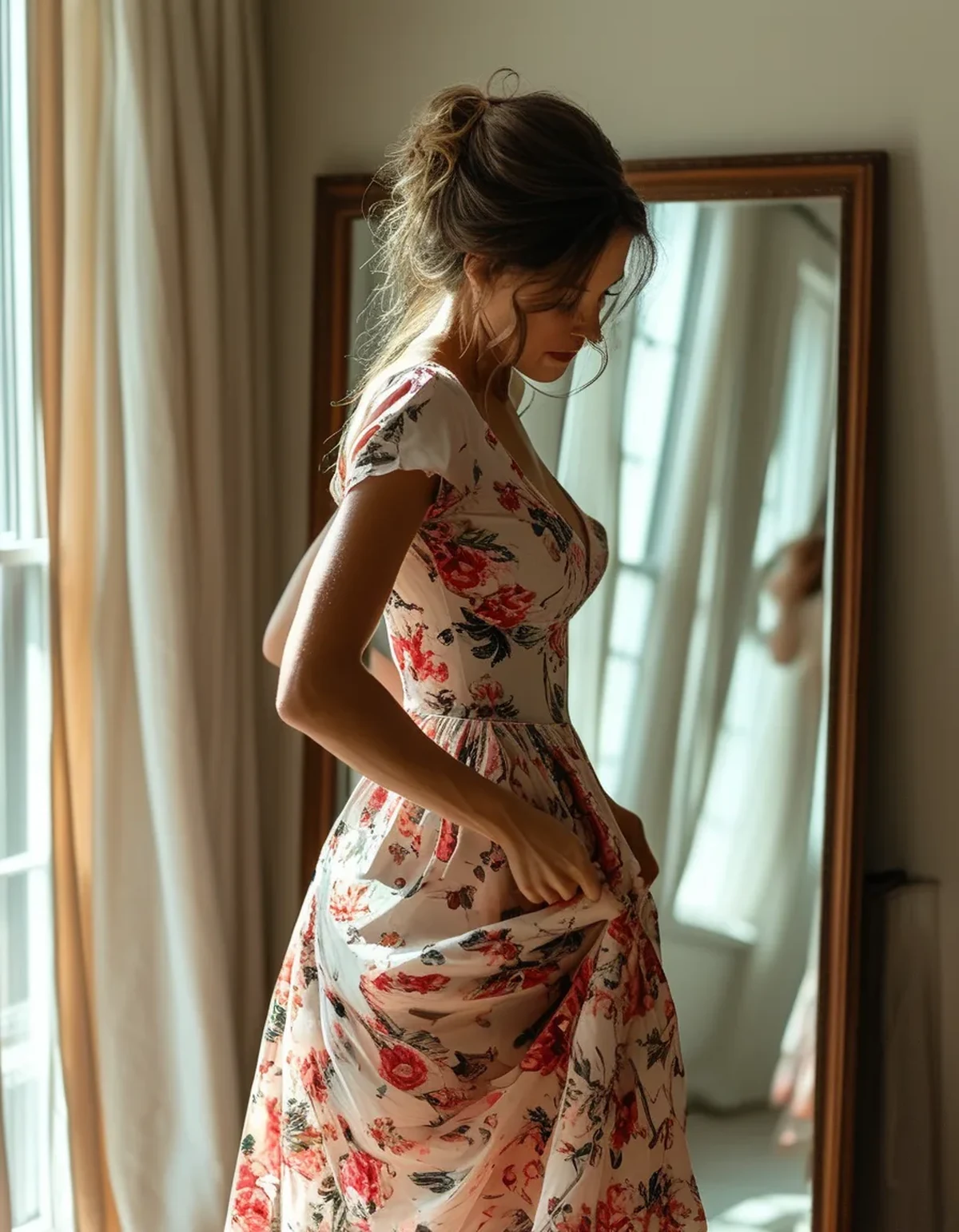
Then the fabric itself gets recruited. A dress hangs from your shoulders, and anything that projects forward from that line — a fuller bust — lifts the fabric below it. The hem rises across the front. This is exactly the same mechanism that makes a shirt hem rise over a pregnant belly, and it operates on any forward projection.
In woven fabric, this shows as a hem that dips at the back and lifts at the front. In stretch fabric it shows as the whole garment travelling upward, because the fabric stretches horizontally to accommodate the bust and stretching horizontally shortens it vertically. That is the reason a jersey dress rides up more than a woven one at the same fit.
Add a longer torso, and the effect compounds. A tall person’s shoulder-to-waist distance is longer, so the dress’s waist seam sits above your natural waist, which pulls the whole skirt up from its intended starting point. You lose length at the top and again at the bust, before the skirt has even begun.
How much length are you actually losing?
Enough to change what a dress is for, and it is measurable in a fitting room.
The three losses stack:
- Torso length: a dress designed for a 5’5 frame places its waist seam roughly at that person’s natural waist. On a 5’10 frame the seam sits 2 to 3 inches high, and every inch the waist sits high is an inch the skirt starts higher.
- Bust projection: a fuller bust commonly lifts a front hem by 1 to 2 inches, more in stretch fabric.
- Grading shortfall: sizing up two sizes for the bust adds perhaps half an inch to an inch of total length, against several inches of added width.
Net effect: a dress described as knee-length can arrive several inches above your knee, and one described as midi lands somewhere it was never meant to.
The diagnostic that tells you which loss dominates. In the fitting room:
- Find where the dress’s waist seam sits relative to your natural waist. Above it means torso length is the issue.
- Check whether the front hem is higher than the back hem. If yes, bust projection is lifting it.
- Pull the shoulders up an inch and see whether the fit across the bust improves. If it does, the bodice is too short, not too narrow — a very common misread that leads people to size up when they needed a longer bodice.
That third check is the useful one, because it distinguishes a width problem from a length problem, and the two have completely different solutions.
Which styles solve it and which cannot?
The ones that decouple bust fit from hem position work. The ones that use a single fitted pattern do not.
Styles that work:
- Wrap dresses. The bust is adjusted by how you tie it, independently of the skirt — this is the single most forgiving construction for this exact conflict.
- Empire and raised-waist styles, where the seam sits above the natural waist by design, so a long torso does not displace it.
- A-line and fit-and-flare with a full skirt. A wider skirt has more fabric to give, so bust lift produces less visible hem change.
- Shirt dresses, because the front opening absorbs bust width without recruiting length.
- Two-piece looks that read as a dress — a fitted top with a separate skirt removes the conflict entirely, which is why so many tall curvy women end up here.
Styles that will keep failing:
- Sheath and bodycon dresses. One fitted pattern, minimal ease, maximum sensitivity to both variables.
- Anything described as a mini that you need to size up for. You have no length budget to lose.
- Bandage and heavy compression knits, which shorten dramatically as they stretch.
- Drop-waist styles, which place a seam at a specific point that will land wrong on a long torso.
And the shopping filter that saves the most time: look for a Tall range first, then check the bust. A Tall size 16 usually solves both problems at once, where a regular size 20 solves one and worsens the other. Tall ranges typically add 1.5 to 2 inches of bodice and 2 to 3 inches of skirt length, which is roughly what the stack above costs you.
Myth vs Fact: Tall Curvy Dress Fit
Myth: Sizing up will eventually fix the length too. Fact: Grading adds width generously and length barely at all. Going up two sizes might add half an inch of hem while adding two or more inches of bust circumference. You end up with a dress that is loose at the waist, gaping at the armhole, and still short.
Myth: A hem can always be let down. Fact: Only if there is a hem allowance to let down, and most mass-market dresses have a half-inch to one-inch hem — often overlocked with no allowance at all. Check before buying by folding the hem back and feeling how much fabric is turned under. A generous 2-inch allowance is a genuine buying signal.
Myth: Stretch fabric is more forgiving for tall curvy bodies. Fact: More forgiving on width, worse on length. Stretching a knit horizontally shortens it vertically, which is why a jersey dress rides up in exactly the situation you needed it not to. A woven with a generous cut is often the better answer.
Myth: The problem is your proportions. Fact: The problem is that one pattern is being scaled in one direction to fit bodies that vary in two. A body that is longer and fuller is being served by a grading system that assumes those two things arrive together in a fixed ratio. They do not, and that is a pattern-making limitation, not a body one.
Myth: A tailor cannot help with a hem that is already too short. Fact: A tailor cannot add fabric that is not there, and they can do several other things: let out side seams, lower a waist seam, add a contrast band at the hem, or convert a dress to a top. A hem band in a matching or deliberately contrasting fabric adds real length and reads as a design feature rather than an alteration.
What is the actual shopping and fitting strategy?
Measure once, shop Tall first, and check three things in the fitting room every time.
Get your two numbers. Full bust, and shoulder-to-natural-waist length. The second one is the number almost nobody knows and it is the one that predicts whether a dress will work. Measure from the top of your shoulder, over the fullest part of the bust, down to your natural waist. Compare it to the brand’s size chart if they publish it — some do.
Then the shopping order:
- Tall ranges first, at your bust size. This solves the majority of cases in one step.
- Wrap, empire, and shirt dress styles in regular ranges.
- Regular fitted styles last, with realistic expectations.
In the fitting room, three checks, in this order:
- Does the waist seam land at your waist? If not, nothing below it will be right.
- Is the front hem level with the back hem? Uneven means bust projection is lifting it, which a size change will not fix.
- Does lifting the shoulders improve the bust fit? If yes, you need a longer bodice, not a wider one.
Budget for one alteration. A dress that fits the bust and needs the waist taken in is a five-minute job and a transformative one — and it is the correct order to buy in, because width can be removed and length cannot be added.
Keep a note of what works. Brand, size, style name, and which of the three problems it solved. Fit knowledge for a tall curvy frame is brand-specific and it accumulates; it is the single most useful thing you can write down.
Seasonal note: autumn dressing helps you here. Tights and boots change what hem length reads as appropriate, and a slightly short dress that felt wrong in July often works over opaque tights in October — which effectively widens what is wearable for the next several months.
FAQ: Tall Curvy Dress Fit, Answered
Should I buy for the bust or for the length?
Buy for the bust and shoulders, because those cannot be altered easily and a bad fit there is visible immediately. Length is either solved by buying Tall in the first place, or accepted and worked with — over tights, as a tunic with trousers, or with a hem band added. Width taken in at the waist is one of the cheapest alterations there is.
Why do wrap dresses work so much better?
Because the tie lets you set the bust and waist fit independently of everything else, and the skirt overlaps rather than being a closed tube — so bust projection lifts the front without pulling the whole garment up. The one thing to check is coverage at the overlap, which on a taller frame can sit differently than the design intended.
Is it worth having dresses made or heavily altered?
For a few key pieces, often yes. If you have repeatedly failed to find something for a specific need — work, a wedding, a formal event — the cost of altering a well-chosen off-the-rack dress or having one made from a pattern graded to your measurements compares reasonably to buying three that never quite worked. Start by finding one dress that fits well and using it as a reference for the measurements that matter.
TL;DR:
- Grading adds width generously per size and length barely at all, so sizing up for the bust never buys back the hem
- Fabric pulled across a fuller bust is fabric taken from the vertical, which is why the front hem lifts
- A long torso puts the waist seam high, so the skirt starts higher before the bust effect even applies
- Shop Tall ranges at your bust size first, then wrap, empire, and shirt dresses; avoid sheath and mini styles
- Check three things in the fitting room: waist seam position, front-versus-back hem, and whether lifting the shoulders improves the bust
The dress is not lying about its length — it is just measuring from a waist seam that landed three inches above yours, on a bust that borrowed the rest. Buy the version that was cut longer to begin with, and the conflict simply stops existing.
Keep Reading
This article is for general informational and styling purposes only. Fit, sizing, and product availability may vary.