Why Tall Curvy Coats Always Fit the Body But Never the Arms
Quick Answer: Coats cut for a curvy fit are designed around bust and hip proportions, but sleeve length is usually scaled to an average height, so tall curvy shoppers get a coat that fits the body but stops well above the wrist.
You finally find a coat that closes properly over your chest and hips without gaping — and then your wrists are hanging out in the cold. Two separate sizing systems collided, and neither one was built with both proportions in mind.
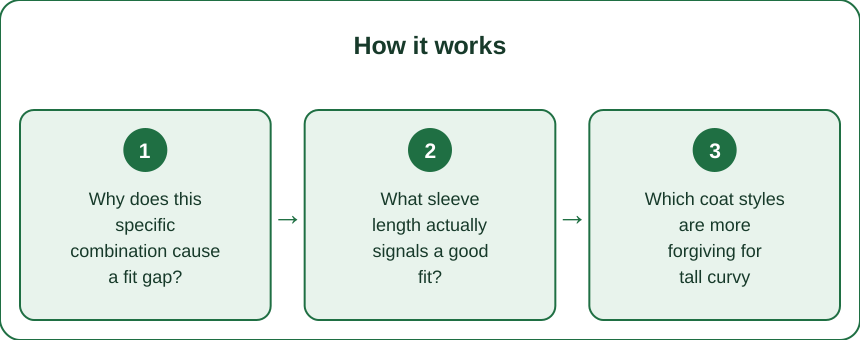
Why does this specific combination cause a fit gap?
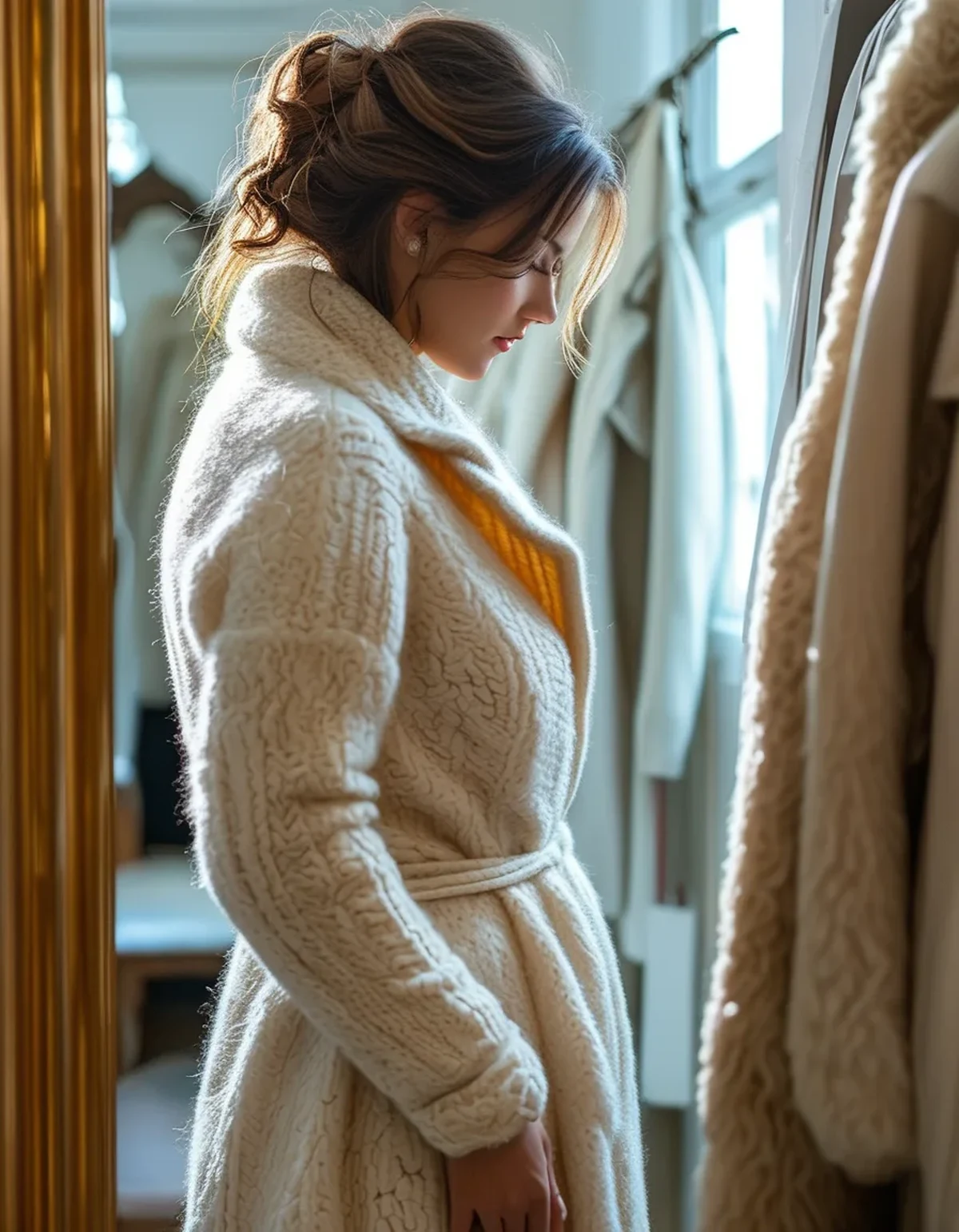
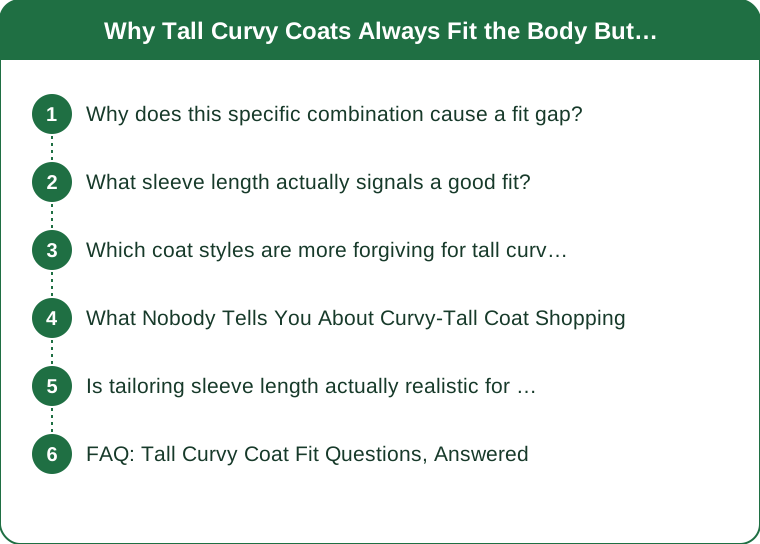
Curvy-fit coats are graded primarily around bust, waist, and hip measurements, since that’s the proportion difference most brands are solving for. Sleeve length, by contrast, is usually graded off overall garment size rather than actual arm length, which means it’s calibrated for an average height within that curvy size range — not a taller one.
The result is two separate proportion problems stacked on top of each other: the coat body might be cut generously enough to fit well, while the sleeves were never adjusted upward to match a taller frame.
What sleeve length actually signals a good fit?
A coat sleeve should end at or just past the wrist bone with your arm relaxed at your side, leaving enough room to comfortably layer a sweater underneath without the cuff riding up. If sleeves stop mid-forearm with your arms down, that’s a clear sign the coat was cut for a shorter torso-to-arm ratio than yours, regardless of how well the body fits.
Raising your arms slightly and checking where the sleeve settles gives a more realistic read than just standing still — coats that look fine at rest often reveal their true length the moment you reach for something.
Which coat styles are more forgiving for tall curvy proportions?
Raglan sleeve construction (where the sleeve extends in one piece up to the collar rather than a separate set-in seam at the shoulder) tends to run slightly longer and more adjustable than traditional set-in sleeves, making it a safer bet when shopping without trying on first. Wrap coats and belted styles also give more flexibility since the closure isn’t fighting against a fixed shoulder seam the way structured blazers do.
Brands that specifically offer ‘tall’ as a separate size dimension (not just a curve or plus designation) are worth prioritizing, since they’re the ones actually solving both proportions at once rather than picking one.
What Nobody Tells You About Curvy-Tall Coat Shopping
Most style guides treat ‘curvy’ and ‘tall’ as separate shopping categories, but they rarely mention that very few mainstream brands size for both simultaneously, which is why the search feels harder than either category alone. Specialty and tall-focused labels are more likely to have solved this than general plus-size lines that scaled up an average-height pattern.
They also don’t mention that the shoulder seam placement matters as much as sleeve length — a shoulder seam that sits too far in toward the neck effectively shortens the usable sleeve length even before you measure the cuff, so checking shoulder fit first can save you from buying a coat that looked right on the hanger.
Is tailoring sleeve length actually realistic for coats?
Yes, in most cases — lengthening a coat sleeve is a straightforward alteration as long as there’s fabric allowance in the seam (usually there’s 1-2 inches to work with) or a cuff that can be dropped. It typically costs $20-40 at a tailor and is far more reliable than hoping to find a perfect off-the-rack fit.
The harder alteration is the reverse — a coat that’s already maxed out on sleeve length with no seam allowance can’t be extended further, so it’s worth asking the tailor to check before you buy if you’re between sizes.
FAQ: Tall Curvy Coat Fit Questions, Answered
How much shorter do sleeves typically run in standard curvy coats?
It varies by brand, but 1-3 inches short of the wrist bone is common when a coat is graded for curve without a corresponding tall adjustment.
Should I size up just to get longer sleeves?
Not usually — sizing up to fix sleeve length often overcorrects the body fit, adding excess room at the shoulders and bust that then needs its own alteration.
Are petite-curvy and tall-curvy really just opposite problems?
Essentially yes — petite-curvy shoppers usually deal with excess length, while tall-curvy shoppers deal with shortfall, but both stem from brands treating curve and height as unrelated variables.
TL;DR:
- Curvy-fit coats solve bust and hip proportion but rarely adjust sleeve length for height
- Check sleeve length with arms both relaxed and slightly raised, not just at rest
- Raglan sleeves and wrap styles tend to be more forgiving than structured set-in sleeves
- Sleeve lengthening is a simple $20-40 tailor fix if there’s seam allowance to work with
The body fit and the sleeve fit are solving two different sizing problems — once you know that, shopping (and altering) gets a lot less frustrating.
Keep Reading
This article is for general informational and styling purposes only. Fit, sizing, and product availability may vary.