Why a Tall Inseam and a Curvy Thigh Rarely Arrive Together
Quick Answer: Most tall ranges are made by adding length to a standard block without changing the thigh, hip or rise proportions, so a tall size gives you inches at the ankle and nothing anywhere else. Meanwhile curve-focused ranges widen the thigh and hip but keep a standard inseam. Very few brands grade both dimensions independently. The practical fix is to size for the thigh and then filter hard on inseam, because fabric can accommodate a length compromise far better than a circumference one.
This is a pattern-making problem, not a body problem.
We have covered why tall and curvy sizing gets overlooked twice over, why fit fails at the waistband before the hips, and why stretch fabric fails worse than woven. This is the specific conflict in activewear.
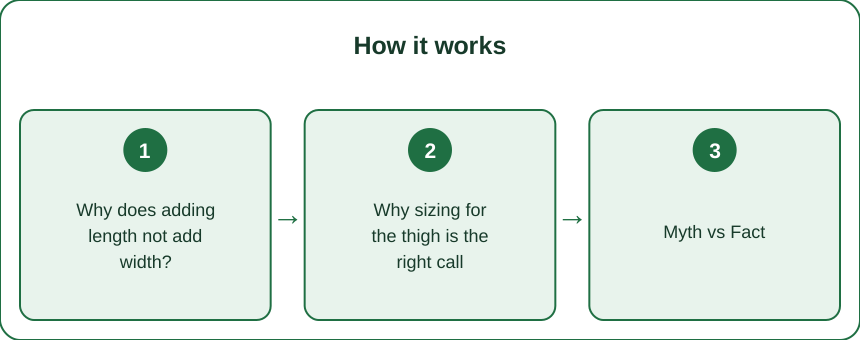
Why does adding length not add width?
Because of how grading works, and grading is a set of rules rather than a measurement of real bodies.
A tall size is usually the same block with length added at defined points — typically the inseam, the rise and sometimes the torso — without altering circumference at all.
Grading rules assume proportional bodies. The maths assumes that as height goes up, circumference goes up by a fixed small increment, which is true on average and wrong for most individuals.
Curve ranges do the opposite. They increase hip and thigh circumference and often keep the inseam at the standard length, because the fit model for that range is standard height.
Two separate ranges means two separate fit models, and almost no brand runs a fit model who is both tall and curvy.
Stretch fabric hides the problem in the fitting room. Everything technically goes on, which is why so many purchases feel fine for ten minutes and wrong after an hour.
And the thigh is where the two ranges disagree most. It is the measurement that varies most between bodies of the same height and the one that grading handles least well.
Why sizing for the thigh is the right call
Because circumference problems have no good workarounds and length problems have several.
A too-tight thigh causes real problems. Seam stress, early opacity failure, restricted movement and a waistband that gets pulled downward with every step.
A too-short hem is mostly cosmetic, and there are styles where it disappears entirely.
Compression is not the same as tightness. Good compression is even across the whole leg. A garment tight only at the thigh is a fit failure, not compression.
Fabric stretched near its limit loses recovery faster, which means the pair you sized down in will go baggy at the knee and sheer at the seat sooner.
A too-tight thigh drags the whole garment down. The waistband rolling is very often a thigh problem presenting further up.
And movement tells you before the mirror does. Deep squat, lunge, high knee. If any of those feel restricted at the thigh specifically, that is the size being wrong regardless of what the hem is doing.

Myth vs Fact: Tall and Curvy Activewear
Myth: Sizing up gets you both the length and the width. Fact: Sizing up in a standard range adds roughly a centimetre of inseam per size, which is nowhere near a tall grade. You get a baggy waist and a hem that is still short.
Myth: Tall ranges are just for very tall women. Fact: They are for anyone whose leg length is long relative to their height, which includes plenty of people of average overall height. Measure your inseam rather than going by your height.
Myth: High-compression fabric solves fit problems. Fact: High compression amplifies them. A firm fabric on a poorly graded pattern is more uncomfortable than a soft one, not less.
Myth: A 7/8 length is a good compromise. Fact: It can be, and on a longer leg a 7/8 often lands as an awkward mid-calf rather than the intended above-ankle. Check the stated inseam, not the style name.
Myth: All brands measure inseam the same way. Fact: They do not. Some measure from crotch seam to hem, some include the waistband. A stated 31 inches from two brands can differ by an inch and a half in practice.
Myth: You will find one perfect brand eventually. Fact: Most tall and curvy shoppers end up with two or three brands that each work for different things. That is not settling; it is how a poorly served fit segment actually gets solved.
How to shop this without wasting a season
Seven habits that cut the return rate dramatically.
Measure your own inseam properly. Barefoot, from the crotch to the floor, then subtract the ankle gap you actually want. Write it down and use that number for everything.
Measure your thigh at the fullest point. Most size charts include it and almost nobody uses it, and it is the measurement that predicts activewear fit best.
Filter by stated inseam, not by the word tall. Tall means different things at different brands, sometimes only an inch.
Read reviews for your combination specifically. Look for reviewers who state both their height and their usual size; a review that says fits great with no numbers is not usable data.
Prioritise brands that grade both dimensions. A small number do offer tall plus, or offer inseam choice independent of size. Those are worth paying for and worth repeating.
Test with movement, not with the mirror. Squat deep, lunge, sit cross-legged. Fifteen seconds tells you what ten minutes of standing will not.
And keep a note on your phone of what worked. Brand, size, inseam, and one line on the fit. It sounds fussy and it saves several hours and several returns a year.
FAQ: Tall Curvy Fit Questions, Answered
Should I size up for length in leggings?
No. Sizing up in a standard range adds only about a centimetre of inseam per size while adding significantly at the waist. Buy a tall inseam in the size that fits your thigh, and treat the two decisions separately.
Why do my leggings roll down at the waist?
Often because the thigh is too tight. A thigh under tension pulls the whole garment downward with every step, and the waistband is where you notice it. Check the thigh fit before you assume the rise is wrong.
How do I know if a tall size will actually be long enough?
Use the stated inseam measurement, not the label. Measure your own inseam barefoot from crotch to floor, subtract the gap you want at the ankle, and compare that number directly. Brands define tall very differently.
TL;DR:
- Tall ranges add length without width; curve ranges add width without length. Very few brands grade both.
- Size for the thigh. Circumference problems have no workaround; length problems have several.
- A rolling waistband is frequently a thigh fit problem showing up further up the garment.
- Shop by stated inseam in centimetres, not by the word tall, and keep a note of what worked.
The pattern is the problem, not your proportions. Buy for the measurement that cannot be compromised.
See It in Motion
Seen here: High Waist Yoga Leggings with Side Pockets — shop it on bubblelime.com
Keep Reading
This article is for general informational and styling purposes only. Fit, sizing, and product availability may vary.